Solar + Battery for Tamil Nadu Power Cuts
Why a normal on-grid system switches off in a power cut, how hybrid solar keeps your fans, Wi-Fi and fridge running, and how big a battery your home really needs.
 Rainbow Solar Energy Team
8 min read
Updated
Rainbow Solar Energy Team
8 min read
Updated
In this article
Key takeaways
- A standard on-grid system shuts down during a power cut for safety, even on a sunny day.
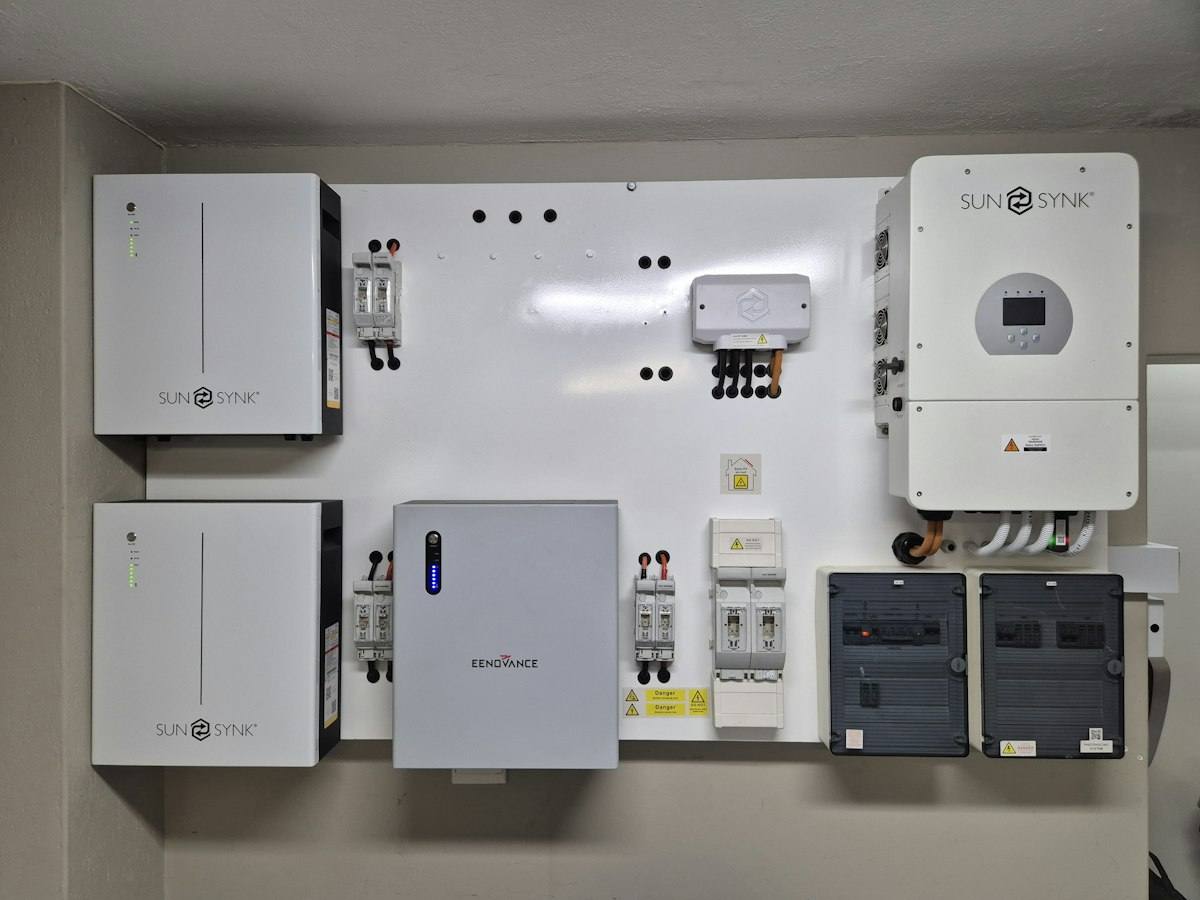
- A hybrid system adds a battery and a hybrid inverter, so essential loads keep running when TNPDCL supply fails.
- Most Tamil Nadu homes need 5 kWh of lithium storage for 4–6 hours of fans, lights, Wi-Fi and the fridge.
- The PM Surya Ghar subsidy covers the grid-connected solar part; batteries are not subsidised.
Tamil Nadu's power supply is far better than it was a decade ago, but most homes still face scheduled maintenance shutdowns, transformer faults in summer, and long outages after cyclones, as many neighbourhoods saw after Cyclone Michaung in 2023. If you work from home or have elderly family members, backup matters. Here is how solar can help.
Does on-grid solar work during a power cut?
No. An on-grid inverter needs grid voltage to run. When TNPDCL supply fails, it switches off within a fraction of a second. This is called anti-islanding, and it protects line workers repairing the cables from your solar power. So a normal net-metered system saves you money but doesn't give backup.
You have three ways to get backup with solar:
| Option | How it works | Backup in a power cut | Best for |
|---|---|---|---|
| On-grid + existing UPS | Solar cuts your bill; your old home inverter/UPS still provides backup from the grid | Only what your UPS battery holds | Low budget, short cuts |
| Hybrid solar + battery | Panels power the home, charge the battery and export surplus via net meter | ✓ Seamless, recharged by the sun | Most Tamil Nadu homes |
| Off-grid solar | No grid connection; everything runs from panels and battery | ✓ But no net metering or subsidy | Farmhouses, remote sites |
Already have a home UPS? Keeping it alongside a new on-grid system is the cheapest way to get bill savings and basic backup. You can upgrade to hybrid later.
How a hybrid solar system works
- DaytimePanels power your home first, then top up the battery, then export any surplus to the grid through the net meter.
- EveningYour home draws from the grid, or from the battery if you set it to cut peak usage.
- Power cutThe hybrid inverter switches essential circuits to the battery in milliseconds. Fans keep spinning and Wi-Fi stays on.
- Next morningThe sun recharges the battery, even if the grid is still down.
How big a battery do you need?
Size the battery for your essential loads, not the whole house. A simple formula: essential load (kW) × hours of backup ÷ 0.9 (to allow for usable capacity and losses).
| Essential loads | Approx. load | Battery (lithium) | Backup time |
|---|---|---|---|
| 4 fans, 6 LED lights, Wi-Fi, TV | ~400 W | 2.5 kWh | ~5 hours |
| Above + refrigerator | ~600 – 700 W | 5 kWh | ~6 hours |
| Above + water pump + laptops | ~1 kW | 5 kWh | ~4 hours |
| Above + one 1.5-ton AC | ~2.2 kW | 10 kWh | ~4 hours |
Indicative. Running ACs, geysers or induction cooktops on battery needs much more storage, so most homes keep them off the backup circuit.
Lithium vs lead-acid batteries
| Lithium (LFP) | Lead-acid (tubular) | |
|---|---|---|
| Lifespan | 10+ years (4,000–6,000 cycles) | 3 – 5 years |
| Usable capacity | 80 – 90% | ~50% |
| Maintenance | None | Distilled-water top-ups |
| Space & weight | Compact, wall-mounted | Bulky, needs ventilation |
| Charging from solar | Fast, efficient | Slower, more losses |
| Upfront cost | Higher | Lower |
| Cost over 10 years | Lower | Higher (2–3 replacements) |
For daily solar cycling in Tamil Nadu's heat, we recommend LFP lithium. It lasts several times longer and gives almost twice the usable energy for the same rated size.
Find the right backup for your home
Our engineer lists your essential loads and designs a hybrid system that fits your budget.
What does solar + battery cost in Tamil Nadu?
| Setup | Indicative price | Notes |
|---|---|---|
| 3 kW on-grid (no battery) | ₹1.70 – ₹1.90 lakh | Before ₹78,000 + ₹22,000 subsidy |
| 3 kW hybrid + 5 kWh lithium | ₹3.0 – ₹3.8 lakh | Subsidy applies to the eligible solar part only |
| 5 kW hybrid + 5 kWh lithium | ₹4.0 – ₹4.9 lakh | Most popular backup setup |
| 5 kW hybrid + 10 kWh lithium | ₹5.2 – ₹6.4 lakh | Backup for one AC as well |
| Add battery to existing hybrid-ready system | ₹1.0 – ₹1.6 lakh per 5 kWh | If your inverter supports it |
Indicative prices including installation and GST. Battery prices are falling year on year.
For the solar-only costs and subsidy maths, see our Tamil Nadu solar price guide and the PM Surya Ghar subsidy guide for Tamil Nadu.
Is a battery worth it for your home?
A battery doesn't make solar pay back faster; net metering already “stores” your surplus in the grid for free. You pay for a battery for comfort and continuity. It is usually worth it if:
- You work from home and can't lose Wi-Fi and laptops during the day.
- You have elderly family members, infants or medical equipment at home.
- Your area sees frequent or long cuts, or was badly hit in past cyclones.
- Your old UPS batteries are due for replacement anyway.
If cuts are rare and short, an on-grid system plus your existing UPS is the most cost-effective choice. You can choose a hybrid-ready inverter now and add a battery later. See how it works on our hybrid solar page or explore solar for homes.
Cyclone-ready installation
Backup is only useful if the system survives the storm. We use hot-dip galvanised structures anchored for coastal wind loads, IP-rated outdoor enclosures, surge protection and proper earthing, and we install batteries indoors or in a shaded, ventilated spot away from flooding risk.
Written by our solar engineers and subsidy specialists, who design and install rooftop systems for homes, societies and businesses across Tamil Nadu. Figures are indicative and reviewed regularly; your free site survey gives exact numbers for your roof.